Upside Down
24th November 2025Words by Fahad Malik.
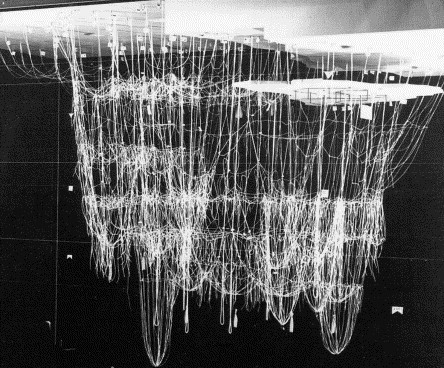
Sometimes you have to hang something upside down to figure out how to hold it up. I remember seeing this in a hanging chain model for the church of Colònia Güell many years ago. There was no software or calculations of loads, just some strings and the pull of gravity, creating elegant and inevitable structures. Gaudi's hanging chain models were radical in their simplicity- fix chains at two ends and flip them and there it is: catenary arches under pure compression.
It was so manual, in a way we might have lost touch with working largely digitally, with generative scripts over the shoulder. It was just a way to illustrate real gravity, so you could touch the forces at play. It wasn't about imposing shapes, it was about uncovering them based on what gravity wants.
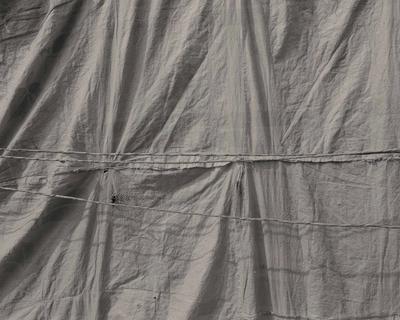
Around the same time, I had been looking at the research of Frei Otto. While Gaudi worked with compression, Otto worked with tension. Instead of hanging chains, he stretched fabrics. Instead of flipping a model, he sprayed soap film over wire frames and let gravity decide: the minimal surface, the most efficient path, the least resistance. Lightness made visible.
Two opposite approaches: One pulling down, the other pulling out. One in stone and one in cloth. However the mindset was the same, trusting beauty in the natural resolution of loads. Not making a shape but finding one that already wants to be there.
We're slowly trying to come back to this idea, especially as the screen gets too loud and the process gets too clever. The goal isn’t to go back, but to fold some physical intuition into how we work now. Maybe we just need to flip it upside down.